
Access to Technology for Immigrant Students

6999459456_38f532a9b2_z

School administrators are looking to Bring Your Own Device (BYOD) policies as a way to bring technology resources in the community to bear in the classroom when there is little funding for school-owned devices. We are examining how three different teachers in three completely different communities — urban, rural, and immigrant — are dealing with BYOD issues, including trust, equity, and what happens when teachers try to put student-centered learning in the hands of students who’ve never experienced it.

The advantage of BYOD has always been flexibility — educators don’t have to wait until a school board approves funds for mobile technology, rolls out a policy and implements a training program. Instead, teachers began experimenting with technology to engage learners and allow them to have more ownership over their learning. Using student-owned devices has the added benefit of helping students to see their phones as learning tools that can be used for research at home. And while not all kids own smartphones or tablets to access the internet outside of school, many do.

School districts that can afford it are opting to issue school-owned devices to students that stay at school. But the drawback to these types of one-to-one programs is that they don’t allow for anytime/anywhere learning. Other schools are combining BYOD with school devices as a way to help mitigate equity gaps.

In this article, we learn how a ninth-grade teacher handles BYOD issues with a mostly immigrant population.

(Read Part 1: Trust, Equity, and Student-Centered Learning With Fourth-Graders.)

PART 2: BYOD AND IMMIGRANT STUDENTS

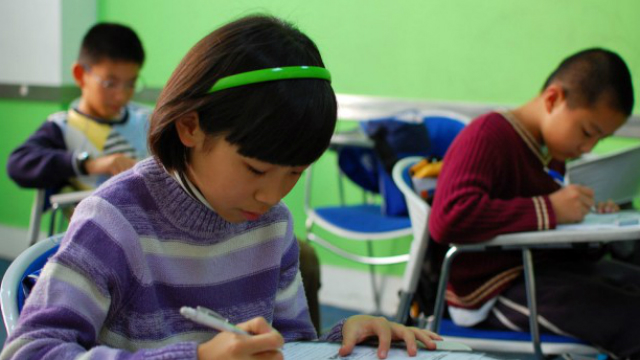
At Washington Technology Magnet School  in St. Paul Minnesota, many students are recent immigrants from Burma, Bhutan, and East African countries like Somalia and Ethiopia. There’s also a sizable Hmong population. The school’s diverse student population represents a shift experienced in schools across the country towards more immigrant children and English Language Learners.

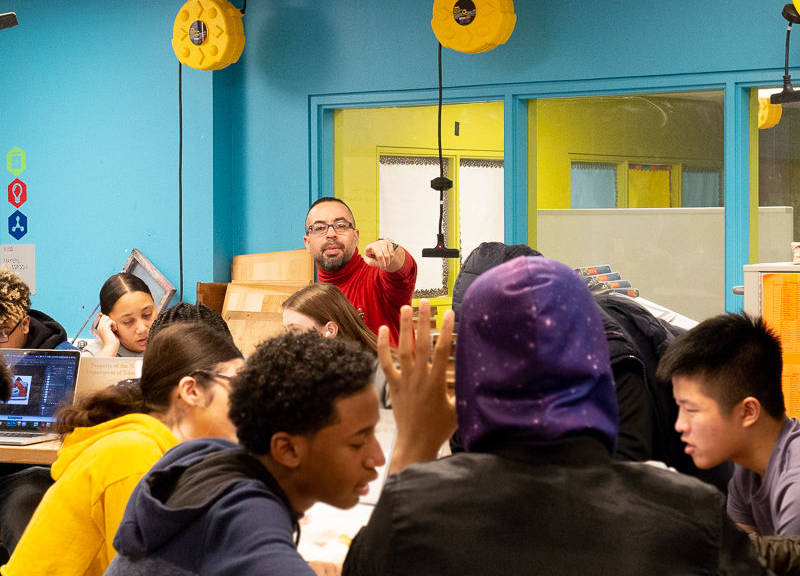
In Stephanie Erickson’s ninth-grade Life Science class, students speak four or five different languages and have different levels of access to technology. Many newer immigrants have no phones at all. Other low-income students have devices, but not access to the internet at home. “It needs to be school-provided because they don’t have them and they can’t get them,” Erickson said.

The official school policy on BYOD allows students to use personal devices to aid learning, but it hasn’t become a huge part of instruction because only some students have them. A few students use their phones to take pictures of notes or to use flashcard apps, but most of the technology in the classroom is school-issued. The leadership at Washington Tech is supportive of teachers trying to integrate student-owned devices, even sending along articles and ideas to the whole staff, but Erickson has been hesitant to embrace that freedom because of concerns that not all her students will be able to participate.

Equitable access to devices comes up a lot in discussions of BYOD, but teachers committed to making technology work for them in the classroom often find learning can be just as powerful without one-to-one programs. In a MindShift article from several years ago, sixth grade teacher Bill Ferriter noted that teachers are always dealing with a deficit of resources, but that shouldn’t prevent change. “If I can have kids work in groups of three—something that I do 9 days out of 10 anyway–then I really only need one student to have a cell phone with unlimited texting,” Ferriter writes. “The odds of that are pretty high in most middle schools. From there, groups can do anything.”

Erickson isn’t entirely sure how many kids have devices, but she knows that only 30 percent of her 150 students use Remind, an app that lets teachers text students reminders en masse. The wide range of experience with technology has made Erickson wary of making devices central to her teaching. She did an informal survey with her students after trying to flip a lesson, asking students to watch a video at home so class time could be devoted to discussion and real-world problems. She found that 95 percent of her students liked the flip model, but only 50 percent could watch videos at home.

[contextly_sidebar id=”j14zEk1mjQz5znbmkh0MQxsjDrUvPMkl”]

Still, she’s found some value in her experiments. “I think a major shift I’ve made is that everyday, the kids get immediate feedback,” Erickson said. She uses clicker apps to ascertain whether students are following and understanding the lesson, for example. But she hasn’t been able to turn control over to students so they can have more input into how they will learn.

“My concern — and maybe it’s just a fear rather than a real thing — is my English Language Learners who have only been here one or two years,” Erickson said. “I think they wouldn’t know where to start.” Students have trouble designing their own science experiments and Erickson doesn’t want to saddle them with the responsibility of directing their own learning when they’re adjusting to a new language and school system at the same time.

“They don’t have the academic language yet to show any critical thinking because that’s where they’re at in their language development,” Erickson said. “To do student-centered, you need to do some critical thinking and show it.” This is a common dilemma for teachers who don’t speak the same first language as their students. But educators at schools in the Internationals Network would disagree with Erickson’s hesitation to ask students to demonstrate critical thinking skills for fear their grasp of the language isn’t strong enough.

“You don’t have to know how to read and write to think deeply,” said Claire Sylvan, founding executive director of the Internationals Network during a Deeper Learning MOOC. Instead, she suggests engaging students with complex thinking on projects that use both English and a student’s’ native language. “Provide them with on-ramps that allow them to develop literacy in the environment that they now inhabit,” she said. The pedagogy behind the Internationals Network focuses on helping students develop literacy and critical thinking skills simultaneously by giving them more freedom to explore their interests in school.

While Erickson hasn’t seen how BYOD or even school-provided iPads have helped to engender student-centered learning, or put learning in the hands of students, she has used school-issued devices to help differentiate learning for the wide variety of learners in her classroom. She gives students extra research options so they can delve more deeply into lab work, and takes time to process what they’ve learned with her later. One day a week she has an intervention day, asking students to review topics they find difficult through video and discussion.

Meanwhile, her school is moving towards an approach that favors technology in the classroom. The goal is to have a Chromebook cart in every classroom to help make sure students have the tools to work at their own pace. In this vision, students would get individualized homework, based on where they are in the course. Erickson says the IT team needs to do significant upgrades to the wireless system before the vision can be implemented.

“My dream is that the kids grab a device and they’re on right away,” Erickson said. “There’s no logging in and no delay because of the wifi. The kids can get what they need to learn for that day. They get the slides and what’s going to be projected. They get some sort of way to get formative assessment with teacher feedback, and if it’s more of an intervention lesson, the kids know exactly what they need to do that day.”

That dream is within sight, but Erickson’s frustration with the technical performance of devices in the classroom have kept her from embracing it wholeheartedly.
Rethinking Assessment: Trusting Teachers to Evaluate Student Learning

test-taking

After more than ten years of national education policies like No Child Left Behind and Race to the Top, the words accountability and assessment have become synonymous at many public schools with high-stakes testing. The two government programs have attached consequences and rewards to standardized test scores, leading many educators to believe they have to teach to the test. But, as the well-known argument goes, teaching prescribed math and reading content doesn’t help students build the skills like creativity, problem-solving and adaptability they need to adapt in the world outside of school.

Many educators are hoping that as Common Core State Standards roll out across the country, teaching and assessment can focus more on problem-solving and the process of getting to an answer, rather than a focus on the answer itself. But, even those process-oriented skills will be assessed with a standardized test – either the Smarter Balanced Assessment or Partnership for Assessment of Readiness for College and Careers (PARCC).

The Smarter Balanced Consortium conducted a pilot of their test earlier this year to help participating schools get a sense of what the tests would be like, as well as to evaluate logistical challenges in administering the computer-based test. An Education Week article explains:

The biggest idea that the pilots underscored for many educators was that the key for getting ready for the tests is not just getting the technology ready, but also having students and teachers know the standards.

“I think we have to make sure we are teaching and assessing with intent on the common core,” Henson [a Michigan superintendent of instruction] says. “It is really skills-based. Reading, writing, and listening skills are a huge part of being able to take that test.”

The article indicates that teachers will still be teaching to the test — they’re just hoping the test will measure how a learner thinks, not just what they’ve memorized. That’s the big question, and early studies suggest they will.

One report [PDF] conducted by The National Center for Research on Evaluation, Standards & Student Testing, or CRESST, at the University of California, Los Angeles indicates that the new tests “are likely to represent important goals for deeper learning, particularly those related to mastering and being able to apply core academic content and cognitive strategies related to complex thinking, communication, and problem solving.”

[RELATED READING: Will the New Online Standardized Tests Be Different?]

But other education researchers wonder if high-stakes testing in any form can truly measure the skills that not only deepen learning, but turn a student into a life-long learner.

“People often try to figure out what makes a difference in education and they try to find different variables that might explain that difference,” said Brent Duckor, a professor at San Jose State University focusing on assessment. “It’s been harder for people to measure, and put the resources around measuring, the so-called soft skills — let’s call them resiliency, persistence, a sense of caring and engagement with school — and to use those in conjunction with the more typical academic achievement measures.” The benefits of the harder-to-quantify skills aren’t easily disentangled from academic achievement scores, making it hard to prove through tests that alternative teaching and learning styles can achieve measurable outcomes.

This tension arises clearly with one of the hottest topics in education right now – project-based learning. Many educators hope this method of teaching content through inquiry and exploration will implicitly deepen learning and shift it towards the goals outlined in Common Core.

“If we are going to measure something, it’s going to take time and it’s going to take resources and effort,” said Duckor. “And what we’ve seen is a lot less attention on measuring those skills in any rigorous or reliable way.” It would take much more time and money to really develop assessments that measure creativity or resilience, but states have neither the time, money nor political will to do so, Duckor said.

“To the extent that policymakers can go back to the drawing board and say, ‘How could Smarter Balanced find ways to investigate the validity and the reliability of teacher claims,’ we could say there would be an advance,” Duckor said. He’d like to see more alternative methods of assessment used.

School-based accountability, where student achievement and progression is determined by teachers, not a state test, is one such method that’s already been studied by researchers. New York City’s Central Park East Secondary School, a progressive poster child in the 1990s, provides an example of how school-based accountability works.

[RELATED READING: How Do You Measure Learning?]

Central Park East developed systems to assess student work that meet the criteria for authentic assessment that well-known researchers like Stanford’s Linda Darling Hammond have determined to be successful. In a soon-to-be-published article, Duckor and co-author Daniel Perlstein argue that the school evaluated projects by asking students to demonstrate knowledge, understand various perspectives on it, connect it to other learning, make conclusions based on varying sets of conditions and be able to discuss its relevance. Most of these elements were included in subject-based portfolios that students created and had to defend in front of a committee that included teachers, students and outside adults.

But Central Park East’s modelcouldn’t hold up to the strong pressures for standardized testing. “The pressures to develop easily measured and easily routinized forms of assessment, and easily measured and easily routinized forms of teaching and learning, in turn, made the school increasingly less successful and less central to reform,” said Daniel Perlstein, professor of education history at the University of California, Berkeley. There has always been a reform movement pushing for more democratic and socially oriented education in the U.S., but historically those efforts haven’t faired well on tests.

“The American educational system was as successful in the absence of high-stakes standardized, centralized forms of assessments, as it is now, perhaps more successful,” said Perlstein. “There are various forms of accountability and the notion that we have to make accountability an easily measurable test item is one notion of accountability, but by no means the most useful for kids, for teachers or for the society as a whole.”

Perlstein points to other measures of a school’s success. Are parents satisfied with the education their children are receiving? Are students engaged and excited to come to school? Those are measures of accountability that don’t carry much weight when it comes to funding, teachers salaries or national rankings, but might be the most important for encouraging life-long learners.

Moving away from tests as the only means to measure knowledge, both at the school level and on state tests, frees teachers up to teach in more dynamic ways. “It’s a question of whose accountability and for whose good,” said Duckor. “And what infrastructure do we have to support communities that would like to have school-based accountability, but at this point are being measured by somebody else’s yardstick?”

For Perlstein, it comes down to the basic fact that teachers, students and schools have a deep capacity for engaging, thoughtful work, but aren’t often given the credit for their efforts. “In schools across the country teachers are trying to figure out how to do their job better,” said Perlstein. “The systems of accountability we have, rather than helping them do that, typically get in the way of that.”